

88% of Pakistanis Face Electricity Load-Shedding, 14% Endure Over 12 Hours Daily: Gallup Survey
Friday, 27 November 2026
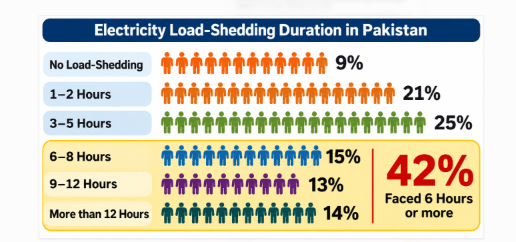
Rural communities bear the brunt of prolonged power outages, with 32% reporting at least nine hours of load-shedding compared with 20% in urban areas; only 9% nationwide report uninterrupted electricity.
Hamid Khan Wazir
ISLAMABAD: Electricity load-shedding continues to affect an overwhelming majority of households across Pakistan, with 88% of citizens reporting power outages in their areas, while 14% endure more than 12 hours of daily electricity cuts, according to a nationwide Gallup & Gilani Pakistan survey released on Thursday.
The survey findings highlight the persistent electricity crisis and its unequal impact on urban and rural communities, with rural residents significantly more likely to experience prolonged power outages. Despite ongoing efforts to improve electricity supply, only 9% of respondents said their areas remained free from load-shedding.
According to the survey, 25% of adult Pakistanis reported experiencing three to five hours of electricity load-shedding in their areas, making it the most commonly reported duration. Another 21% said they faced one to two hours of power outages, while 15% reported six to eight hours of daily load-shedding.
The situation was considerably worse for a substantial section of the population, with 13% reporting nine to 12 hours of electricity cuts and another 14% experiencing outages lasting more than 12 hours. Meanwhile, 9% said they had experienced no load-shedding, while 3% were unable to provide an answer.
The rural-urban divide emerged as one of the most significant findings of the research. Around 32% of rural respondents reported experiencing at least nine hours of electricity load-shedding, compared with 20% of their urban counterparts, indicating that prolonged power outages remain a greater challenge for communities outside major urban centres.
Conversely, urban residents were more likely to report uninterrupted electricity. While 12% of urban respondents said their areas had experienced no load-shedding, the corresponding figure for rural respondents stood at just 7%.
The disparity was also evident in shorter durations of power outages. Around 26% of rural respondents reported three to five hours of load-shedding, compared with 24% of urban residents. However, 26% of urban respondents experienced one to two hours of outages, against 18% in rural areas.
The findings point to persistent inequalities in electricity distribution, with rural communities facing a heavier burden of prolonged outages. Extended power cuts can disrupt household routines, educational activities, businesses, agricultural operations and essential services, particularly in areas with limited access to alternative electricity sources.
The survey was conducted among 859 men and women from urban and rural areas across all four provinces between October 15 and October 22, 2026, using computer-assisted telephone interviews (CATI). The findings carry an estimated margin of error of approximately plus or minus 2-3 percentage points at a 95% confidence level.
Gallup & Gilani Pakistan, the Pakistani affiliate of Gallup International, conducted and released the research.
About Gilani Research Foundation
Gilani Research Foundation is a non-profit public service initiative established to promote social science research and make findings accessible to students, academics, policymakers and concerned citizens in Pakistan and internationally.
The foundation is headed by Dr Ijaz Shafi Gilani, a pioneer of opinion polling in Pakistan who established Gallup Pakistan in 1980. Dr Gilani holds a PhD from the Massachusetts Institute of Technology (MIT) and has taught at leading universities in Pakistan and abroad. He currently serves as Chairman of Gallup & Gilani Pakistan.
Gallup Pakistan and Gilani Research Foundation operate as non-partisan research organisations, providing data and analysis without taking policy positions.


More from Pakistan News






Comments
No comments yet. Be the first to comment!
Leave a Comment